startup manifesto
I wrote most of this post during the summer, right after my internship ended. At the time, the people I hung out with and the environment I was in were heavily biased toward the startup world. Now that I’m back in school and doing some work that’s closer to research engineering, I’m a little less swept up by the intense but rewarding experience that startups promise. I’m planning to find a role closer to research next summer so I can have a more holistic view of what kind of career I’d actually enjoy.
Still, something I learned during that startup fever dream that I think still holds true is this:
I want to work on things I care about, with people I genuinely enjoy being around.
interning at a Startup
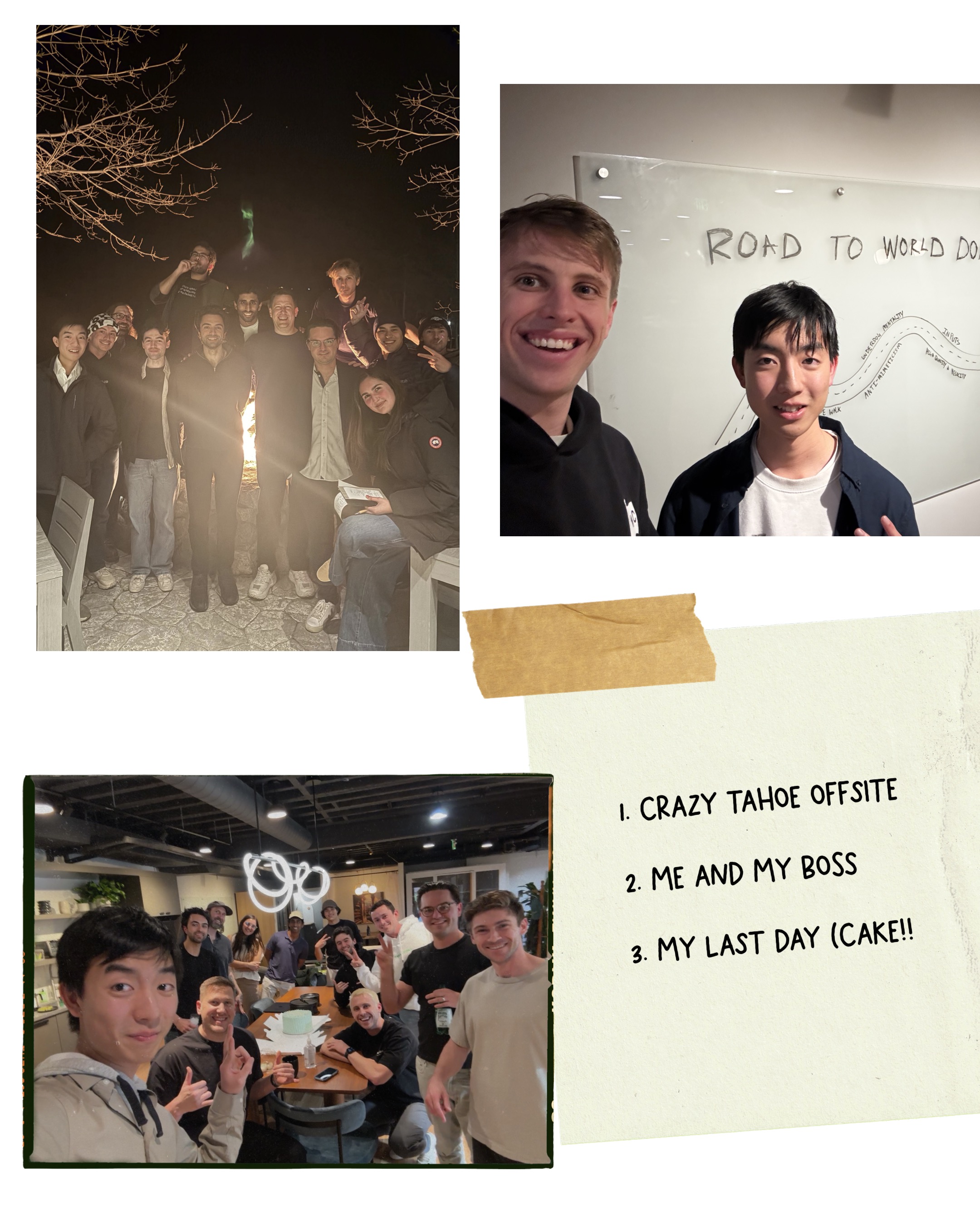
For the first half of this year, I interned at Delphi in SF as a software engineer. My main task was to build a RAG system that served as the memory module of digital clones of famous people (we call them delphis). It was my first in-person, full-time job, and I felt lucky to have landed at a startup with such a strong hustle culture.
It showed me just how intense and stressful startup life can be. I was working six days a week, from 9:30 to 7:30, sometimes staying past 9 pm. Long hours were normalized, and I could clearly feel that everyone on the team wanted to win.
I still remember the day I received my offer letter. Back in Taiwan I used to religiously read startup founding stories on Sequoia’s website (the one about Notion was my favorite). And suddenly I was about to join a Sequoia-backed startup??
I was an international student with broken English and no formal job experience, but the team took a chance on me anyway. They trusted me to build something that directly impacted the user experience. Everyone was kind and supportive, even when I struggled to express myself. They didn’t care about credentials - they cared that I built side projects and was eager to learn.
That internship became a turning point. I improved technically, learned new ways to think about product development, and observed how a high-performing team iterates week by week. Most importantly, it gave me something I desperately needed at the time: proof that I could make it in the US on my own skills.
the unfiltered startup life
Before Delphi, I had a lot of fantasies about startups. I imagined building something cool with friends, while making money and having fun. Some of that was true, but the workload and pressure were much heavier than I expected.
I started asking myself:
Is this the life I want? Do I feel excited enough to do this for a decade?
The answer was yes… and no.
The long hours and constant stress made me doubt how long I could sustain my energy. Each day after a one-hour commute from SF to Berkeley, I came home exhausted. I barely had time for side projects or hanging out with friends. My entire life collapsed into work. (To be fair, part of that was because I was under-skilled at the time and had to learn a lot every day just to keep up.)
I started wondering if this level of commitment was too much for a job.
I would later realize that startups are supposed to be so much more than just a job. It’s your life’s work. Toward the end of my internship, two of my coworkers quit to work on their own ideas. The people who stayed worked so hard because they genuinely believed in what they were building. It’s going to change the world. It will be a category-defining company. It has to, or else they’d be building their own thing or chill at less intense companies.
build your own thing
I still haven’t fully recovered from the shock when my coworkers quit to build their own startup. Neither of them had a green card, which meant they needed to raise $500k and get an O-1 visa as soon as possible or they’d get kicked out of the U.S.
We were all international students, and one of them was only a year older than me. They helped me a lot during my first few weeks. We got lunch together all the time, talked about the company, and discussed the latest AI progress. I knew they were exploring ideas and building demos after work, but I never thought they’d actually quit and go all-in with no safety net.
I remember one conversation clearly. One of them had worked at Google before joining Delphi. He said working at a startup only makes sense if you want to learn how to build one. Otherwise, you’re pouring so much effort into building someone else’s dream. If you want money, big tech pays way more. And if you’re finally going to go all-in, why not build your own thing?
At the time, I thought it was just a joke, a way for us to stay idealistic. But then they actually did it. Watching them take that leap made it real for me. It forced me to stop floating and ask myself harder questions: What kind of work do I actually want to spend my life on?
what kind of work feels right
I recently saw this chart and couldn’t stop thinking about it.
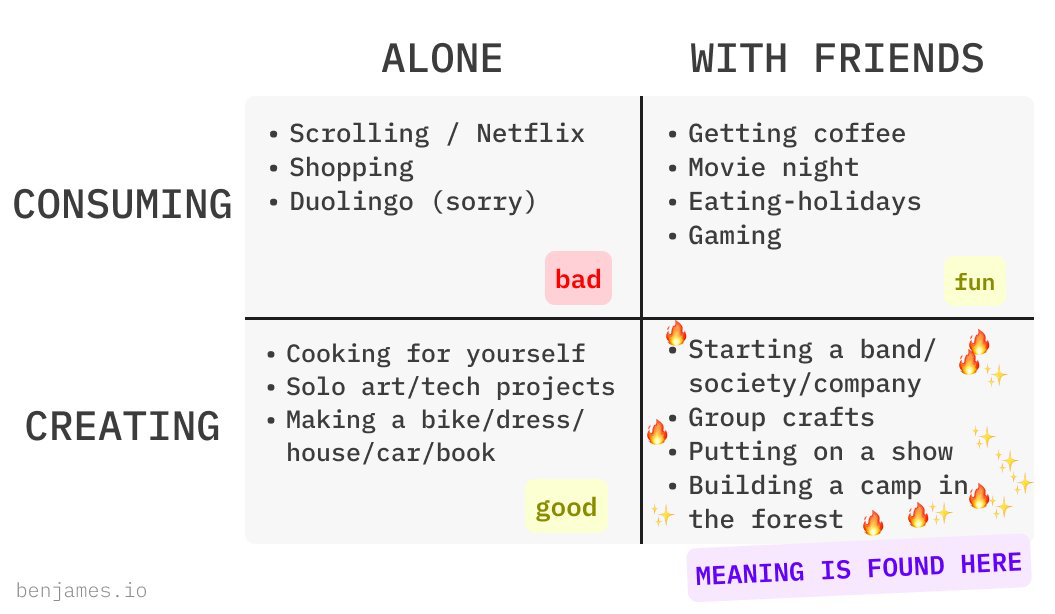
When I think about my career, I get the most excited imagining building something meaningful with people I love. That feels very different from imagining a big-tech software engineering job. That path feels like something I’d do for money or because of expectations.
Some of the startups I’ve seen in SF are just friends building something they think is cool. And honestly, that’s the kind of career that excites me the most. It doesn’t have to be a billion-dollar company. Everyone knows 90% of startups fail, but this time the journey matters more than the outcome.
There’s something special about going from 0 to 1 with a small group. Wake up, grind with friends, get lunch and talk, solve problems together, build something we wish existed. I used to think the product mattered most. Recently, I’ve realized it’s the people that make the journey worth it.
assumption behind startup risk
People always say being a founder is a risky career move. I think that’s only true if your goal is to build a unicorn and get a 100x return. That framing assumes that if your startup fails, the time was wasted.
I don’t see it that way anymore.
I’m at a stage where I genuinely believe the journey matters more than the outcome. I’d do a startup even if I walked away with little money or fame. The process of building is what excites me. I can’t think of a better way to spend my time than going all-in on something I wish existed — especially when I’m young and have nothing to lose.
If the risk is losing money I could’ve earned in big tech, but the reward is finding meaning at work, then give me a thousand lives and I’d still pick the adventurous startup life over being a soulless code monkey.
pick the one with the better story
My internship showed me startups are not a fairytale. If I choose this path, I’m going all-in. I’ll live and breathe the product. I’ll save less money than I would in big tech. I’ll have way less time for hobbies.
It’s too early to say whether this intense lifestyle is something I’ll want five years from now. Perspective changes. But right now, my belief is simple:
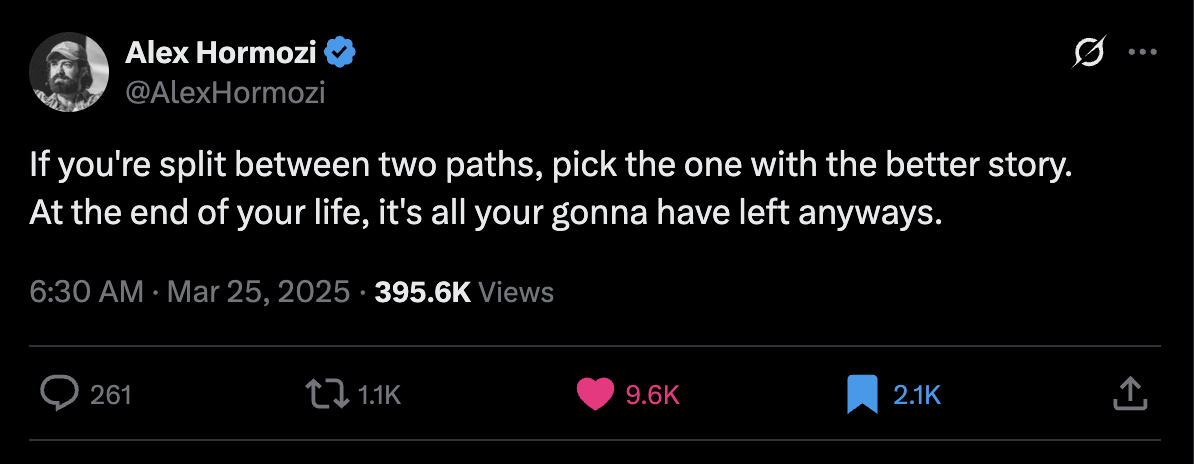
I should pick the life with the better story.
I want to be part of a legendary story. Pull all-nighters to ship something crazy. Land the first big contract. Hear from the first happy user. Get roasted by the first hater. Ride the ups and downs.
Maybe I won’t save money or buy a house by 30. Maybe I’ll eat Chipotle for five years. But that’s okay. I agree with the chart: meaning can be found in these years of grinding and hustling (with friends!)
engineering my future
I’m almost certain I’ll start or join a startup while I’m still young and ambitious. The only prerequisites are:
- Find people I want to build with
- Find a product worth going all-in on
Staying close to SF maximizes my chances of finding the right people. I’ve felt how tough startup life can be, and I know I don’t want to go through it with people I don’t vibe with.
Finding the right product takes time. I always have ideas, but few stick. So I’ll keep experimenting until something does.
The important part is to be intentional. The ideal career won’t just happen. The natural thing is to get a not-bad job and live a not-bad life. But I don’t want to miss the chance to become the best version of myself - only to regret not trying hard enough.
Even when I can only see glimpses of the life I want, it’s still my responsibility to fight for what matters to me. Being agentic matters. Acting decisively matters. Just like my friends didn’t wait for permission to start, I shouldn’t be sitting here hoping for an ideal career. I’m engineering my way into one.
The days ahead are long, and my perspective might change someday. But for now, all I can say is this:
I don’t think I’d be proud of working in big tech and just being a cog in a huge machine. I need something intense, all-consuming — something that, when I look back, leaves me in awe of how far I went because a group of people believed in each other, believed in a shared vision, and decided there was no speed limit. A team that poured everything into it for the love of the game and the mission.
I think that would be a pretty awesome story.